About This Drill
AP Precalculus Transformations of Functions Drill 1 is a Math practice drill covering Transformations of Functions. It contains 5 original questions developed by Brian Stewart, a Barron's test prep author with over 20 years of tutoring experience.
Practice AP® Precalculus transformations of functions, including horizontal and vertical shifts, dilations, and combined transformations. These questions reflect the style and rigor of Topic 1.12 on the official exam.
Questions & Explanations
Question 1. The graph of a function f is shown below.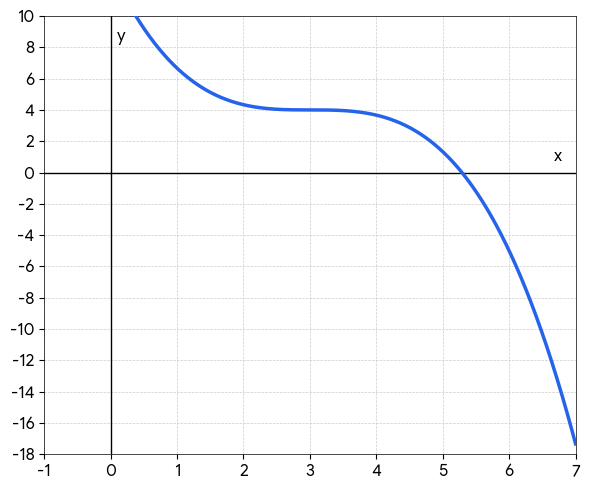
Which of the following describes the graph of g(x) = f(x + 1) − 2 compared to the graph of f?
- A) The graph of f shifted left 1 unit and down 2 units ✓
- B) The graph of f shifted right 1 unit and down 2 units
- C) The graph of f shifted left 1 unit and up 2 units
- D) The graph of f shifted right 1 unit and up 2 units
Explanation: Choice A is correct. The transformation g(x) = f(x + 1) − 2 replaces x with (x + 1), which shifts the graph LEFT 1 unit, adding to the input moves the graph in the negative x-direction, and subtracts 2 from the output, which shifts the graph DOWN 2 units. Every point (a, b) on f maps to (a − 1, b − 2) on g. Choice B is incorrect because replacing x with (x + 1) shifts the graph left, not right; students who reverse the direction of horizontal shifts arrive at this answer. Choice C is incorrect because subtracting 2 from f(x) shifts the graph down, not up. Choice D is incorrect because both directions are reversed: the horizontal shift is left (not right) and the vertical shift is down (not up).
Question 2. Let f(x) = x2 − 4x + 1. Which of the following defines g(x) = f(x − 3)?
- A) g(x) = x2 − 4x − 2
- B) g(x) = x2 − 10x + 22 ✓
- C) g(x) = x2 − 4x + 4
- D) g(x) = x2 − 4x − 8
Explanation: Choice B is correct. Replacing x with (x − 3) throughout: g(x) = (x − 3)2 − 4(x − 3) + 1 = x2 − 6x + 9 − 4x + 12 + 1 = x2 − 10x + 22. This is a horizontal translation right 3. Choice A is incorrect because a student who computes f(x) − 3 (a vertical shift down 3) instead of f(x − 3) gets x2 − 4x + 1 − 3 = x2 − 4x − 2, confusing output subtraction with input substitution. Choice C is incorrect because a student who computes f(x) + 3 (a vertical shift up 3) gets x2 − 4x + 4, again confusing a change to the output with a change to the input. Choice D is incorrect because a student who substitutes incorrectly, applying the shift only to the constant term by computing 1 − 32 = −8 rather than replacing every x with (x − 3), arrives at x2 − 4x − 8. The correct approach requires substituting (x − 3) for x in every term of f.
Question 3. The graph of a function f is shown below.
The function g is defined by g(x) = 2f(x). Which of the following best describes the relationship between the graphs of f and g?
- A) The graph of g is a horizontal compression of f by a factor of ½.
- B) The graph of g is a vertical shift of f up 2 units.
- C) The graph of g is a horizontal stretch of f by a factor of 2.
- D) The graph of g is a vertical stretch of f by a factor of 2, so each y-value is doubled. ✓
Explanation: Choice D is correct. Multiplying the entire output by 2, as in g(x) = 2f(x), is a vertical dilation by a factor of 2. Every point (a, b) on f maps to (a, 2b) on g, the x-coordinates are unchanged and the y-coordinates are doubled. The rate of change of g at any x-value is also doubled compared to f, since the slope of g equals 2 times the slope of f at every point. Choice A is incorrect because f(2x), replacing x with 2x in the input, produces a horizontal compression by factor ½; the notation 2f(x) multiplies the output, not the input, so no horizontal change occurs. Choice B is incorrect because f(x) + 2 produces a vertical shift up 2 units; multiplying the output by 2 scales it proportionally rather than adding a fixed constant. Choice C is incorrect because f(x⁄2) produces a horizontal stretch by factor 2; students who confuse input transformations with output transformations may choose this.
Question 4. The function h is defined by h(x) = f(3x − 6), where f is a function. Which of the following correctly identifies the horizontal dilation factor and horizontal translation applied to f to produce h?
- A) Horizontal compression by a factor of 3, then translation right 6
- B) Horizontal compression by a factor of ⅓, then translation right 6
- C) Horizontal compression by a factor of ⅓, then translation right 2 ✓
- D) Horizontal stretch by a factor of 3, then translation right 2
Explanation: Choice C is correct. Rewriting: h(x) = f(3x − 6) = f(3(x − 2)). Multiplying the input by 3 produces a horizontal compression by a factor of ⅓, every x-value moves ⅓ as far from the y-axis. The expression (x − 2) inside indicates a horizontal translation right 2. Choice A is incorrect on both counts: listing the dilation factor as 3 (the multiplier of x) rather than ⅓ (the actual scale factor) is the most common student error, and reading the translation as right 6 comes from using the constant in 3x − 6 directly without factoring first. Choice B is incorrect because the translation value of 6 results from failing to factor out 3 before reading the horizontal shift; once factored as 3(x − 2), the translation is clearly right 2, not right 6. Choice D is incorrect because multiplying the input by 3 compresses (not stretches) the graph horizontally; students who confuse the multiplier with the stretch factor choose this.
Question 5. The graph of a function f is shown below.
The function g is defined by g(x) = f(2(x − 4)). A student claims: “The graph of g is obtained by translating the graph of f right 4 units and then compressing it horizontally by a factor of ½.” Is the student’s claim correct?
- A) No. The correct sequence is: compress horizontally by a factor of ½ first, then translate right 4 units. ✓
- B) Yes. Translating right 4 and then compressing horizontally by a factor of ½ produces the graph of g.
- C) No. The correct sequence is: compress horizontally by a factor of 2 first, then translate right 4 units.
- D) No. The graph of g is a horizontal stretch by a factor of 2, then a translation right 4 units.
Explanation: Choice A is correct. The transformation g(x) = f(2(x − 4)) is built from f by first compressing horizontally by factor ½ (replacing x with 2x moves all points twice as close to the y-axis), then translating right 4 (replacing x with x − 4). The order matters: compress first, translate second. The student reversed this sequence. If you translate right 4 first and then compress by ½, the effective translation becomes 4 × ½ = 2 units right, shifting the inflection point to x = 2 rather than x = 4, so the graphs are not equivalent. Choice B is incorrect because it accepts the student’s reversed order as valid, which it is not. Choice C is incorrect because the dilation factor for f(2x) is ½ (compression), not 2; students who read the multiplier as the scale factor rather than its reciprocal arrive here. Choice D is incorrect on both counts: f(2x) is a horizontal compression (not a stretch), and the order listed is still wrong.