About This Drill
AP World History Unit 4 Drill 9 is a Multiple Choice practice drill covering Unit 4: Transoceanic Interconnections. It contains 5 original questions developed by Brian Stewart, a Barron's test prep author with over 20 years of tutoring experience.
This drill uses a diagram of the Columbian Exchange to explore the causes and consequences of biological and agricultural exchange between the Eastern and Western Hemispheres after 1492. Study the diagram carefully, then answer all five questions.
Passage
Figure 1. The Columbian Exchange, c. 1492–1600
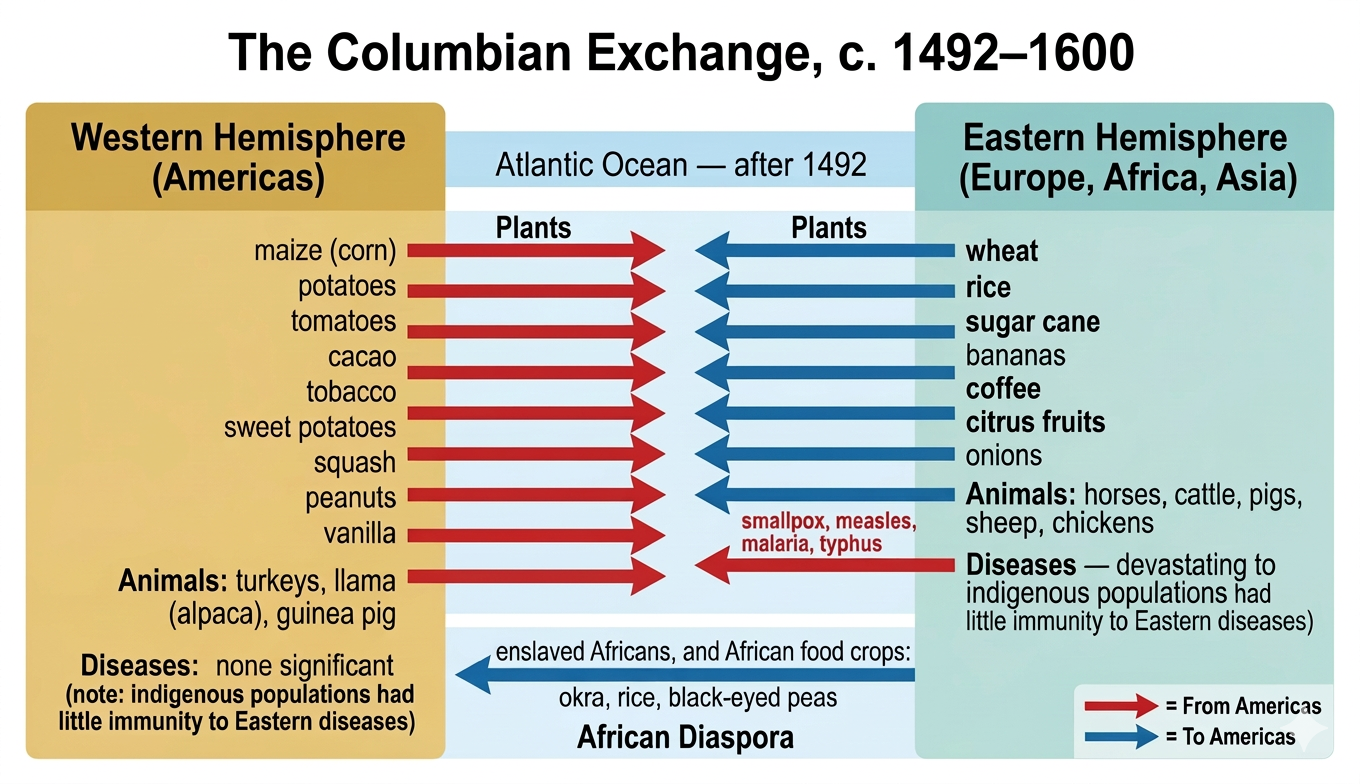
The diagram shows the major biological and agricultural transfers between the Eastern and Western Hemispheres following European contact with the Americas after 1492.
Questions & Explanations
Question 1. Based on Figure 1, which of the following best describes the overall pattern of the Columbian Exchange?
- A) The exchange involved multidirectional transfers of crops, animals, and diseases, with dramatically asymmetric consequences, particularly the devastating impact of Eastern diseases on indigenous American populations ✓
- B) The exchange was primarily beneficial to the Americas, which received more economically valuable crops and animals than it sent to the Eastern Hemisphere
- C) The Americas contributed no significant crops to the Eastern Hemisphere, making the Columbian Exchange one-directional in agricultural benefit and leaving European diets unchanged
- D) The Columbian Exchange was a carefully planned trading system organized by European monarchs to redistribute agricultural resources between hemispheres
Explanation: A is correct. The diagram shows flows in both directions, American crops moving east and European/African crops, animals, and diseases moving west, but the consequences were profoundly unequal. The diseases that moved westward devastated indigenous American populations who had no prior exposure or immunity. B is wrong, the Americas did not receive primarily benefits; Old World diseases were catastrophic for indigenous populations, making the consequences deeply asymmetric against the Americas. C is wrong; American crops including maize, potatoes, tomatoes, and cacao became staple foods across Europe, Africa, and Asia; the Americas made enormous contributions to Eastern Hemisphere agriculture as the diagram clearly shows. D is wrong, the Columbian Exchange was largely unintentional and unplanned; diseases spread through contact, and crop transfers happened organically through settlement and trade rather than royal planning.
Question 2. A historian using Figure 1 should recognize that this type of diagram is most limited because it
- A) was created by European historians who deliberately omitted the African contribution to minimize the significance of enslaved Africans in the exchange
- B) excludes maritime routes and shows only overland connections between the hemispheres
- C) only shows agricultural transfers and completely ignores the movement of people, technologies, and ideas across the Atlantic
- D) shows what was exchanged but cannot convey the timing, speed, or regional variation in how different transfers affected specific populations ✓
Explanation: D is correct. Diagrams of the Columbian Exchange are effective at showing categories of what moved between hemispheres, but they cannot show regional variation (potatoes became crucial in Ireland but were adopted slowly in France), timing (maize spread to Africa relatively quickly while potatoes spread more slowly in Asia), or the lived experience of specific communities who encountered these changes. A is wrong, the diagram includes the African Diaspora section, indicating awareness of African contributions. B is wrong, the Columbian Exchange was an oceanic transfer; the diagram is not about overland routes at all. C is wrong, the diagram does include people (enslaved Africans) in the African Diaspora section, explicitly showing human movement.
Question 3. The introduction of American food crops such as maize and potatoes to Africa and Eurasia, shown in Figure 1, contributed most directly to which broader development?
- A) European nations deliberately cultivated American crops to reduce their strategic dependence on Asian spice trade routes, planting potatoes specifically to undercut the spice market in direct competition with eastern suppliers
- B) Population growth in parts of Europe, Africa, and Asia over the 17th and 18th centuries, as American crops could be grown on marginal land and in climates unsuitable for existing staple crops ✓
- C) Indigenous American peoples deliberately exported their crops to the Eastern Hemisphere to establish commercial relationships with European trading companies
- D) American crops replaced all existing Eastern Hemisphere staple crops within one generation, causing the collapse of traditional agricultural systems across Asia and Africa
Explanation: B is correct. The long-term demographic significance of American crops in the Eastern Hemisphere is a key AP World History concept. Maize could grow in African climates unsuitable for wheat; potatoes thrived in cold, wet soils of northern Europe; sweet potatoes grew on marginal land in China. Over the 17th–18th centuries, these crops contributed to population growth by expanding agricultural productive capacity. A is wrong; American crops were not cultivated as a strategic alternative to Asian spice routes; their adoption was driven by agricultural utility, not geopolitical calculation. C is wrong, indigenous peoples did not deliberately export their crops; transfers happened through European colonization and settlement. D is wrong; American crops were adopted gradually alongside existing staples and did not replace them within one generation; traditional crops remained dominant for centuries.
Question 4. The devastating impact of Old World diseases on indigenous American populations, shown in Figure 1, was primarily caused by which of the following?
- A) European settlers deliberately spread diseases as a systematic weapon of biological warfare against indigenous peoples across the Americas
- B) The diseases that reached the Americas were newly evolved strains equally deadly to European and indigenous populations alike, killing colonizers at the same rate as natives
- C) Indigenous American populations had no prior exposure to diseases like smallpox and measles, so they lacked the acquired immunity that had developed in Afro-Eurasian populations through centuries of contact ✓
- D) Indigenous American peoples had weaker immune systems than Europeans due to nutritional deficiencies and inferior living conditions prior to European contact
Explanation: C is correct. The catastrophic death toll resulted from the absence of prior exposure and the acquired immunity that comes with it. Afro-Eurasian populations had lived with diseases like smallpox for centuries, and survivors passed genetic and acquired resistance to subsequent generations. Indigenous Americans had no such exposure history, the Americas had been separated from Afro-Eurasia for approximately 12,000 years. When contact occurred, indigenous populations faced multiple simultaneous epidemics with no immunity, causing demographic collapse in many regions. A is wrong, while some deliberate uses of biological agents did occur later, the primary driver of epidemic mortality was unintentional transmission through contact. B is wrong, the diseases were not newly evolved; smallpox and measles were longstanding in Afro-Eurasia, which is precisely why those populations had developed greater resistance. D is wrong, indigenous peoples were not nutritionally or physically inferior; they had simply developed immunity to different diseases endemic in their own environment.
Question 5. Which of the following best describes a long-term consequence of the demographic collapse of indigenous American populations caused by the disease transfers shown in Figure 1?
- A) European powers abandoned their American colonies because the loss of indigenous labor made colonization economically unviable, retreating from the hemisphere by the early 1600s
- B) Indigenous American populations quickly recovered their pre-contact numbers within one century, aided by European medical knowledge and improved nutrition
- C) European nations introduced American diseases intentionally to sub-Saharan Africa to weaken potential rivals for control of Atlantic trade routes
- D) The decimation of indigenous labor supplies contributed directly to European demand for enslaved African labor, intensifying the transatlantic slave trade and reshaping the demographic makeup of the Americas ✓
Explanation: D is correct. The demographic collapse of indigenous American populations, reducing some regions' populations by 50–90% within a century of contact, created an acute labor shortage in colonial economies dependent on agriculture and mining. European colonizers turned to Africa as a source of enslaved labor, dramatically intensifying the transatlantic slave trade. This connection between epidemic mortality among indigenous Americans and the expansion of African slavery is one of the most consequential causal chains in early modern world history, reshaping the demographic, cultural, and economic character of the Americas. A is wrong; European powers did not abandon their colonies; instead they intensified colonization and shifted labor sources. B is wrong, indigenous populations did not recover quickly; in many regions, pre-contact population levels were not approached again for centuries. C is wrong, no such intentional disease introduction to Africa occurred; this is historically false.