About This Drill
AP Precalculus: Polar Coordinates & Polar Graphs (Drill 1) is a Math practice drill covering Polar Coordinates & Polar Graphs. It contains 5 original questions developed by Brian Stewart, a Barron's test prep author with over 20 years of tutoring experience.
Practice converting between rectangular and polar coordinates and identifying polar graph families including roses, limaçons, cardioids, and circles. These AP® Precalculus questions cover Topics 3.13–3.14.
Questions & Explanations
Question 1. A point has rectangular coordinates \( (3, 3) \). Which of the following gives the polar coordinates \( (r, \theta) \) of this point, where \( r > 0 \) and \( 0 \leq \theta < 2\pi \)?
- A) \( \left(3\sqrt{2},\ \dfrac{\pi}{4}\right) \) ✓
- B) \( \left(3\sqrt{2},\ \dfrac{3\pi}{4}\right) \)
- C) \( \left(3\sqrt{3},\ \dfrac{\pi}{4}\right) \)
- D) \( \left(6,\ \dfrac{\pi}{6}\right) \)
Explanation: Choice A is correct. Use \( r = \sqrt{x^2 + y^2} = \sqrt{9 + 9} = \sqrt{18} = 3\sqrt{2} \). For the angle, \( \tan\theta = \dfrac{y}{x} = \dfrac{3}{3} = 1 \), and since the point is in Quadrant I, \( \theta = \dfrac{\pi}{4} \). Choice B is incorrect because \( \dfrac{3\pi}{4} \) is the Quadrant II angle with \( \tan\theta = -1 \); the student correctly computed \( r \) but placed the angle in the wrong quadrant. Choice C is incorrect because \( 3\sqrt{3} \) results from computing \( \sqrt{3 \cdot 9} \) rather than \( \sqrt{9 + 9} \); the student multiplied instead of adding under the radical. Choice D is incorrect because \( r = 6 \) comes from adding coordinates instead of using the distance formula, and \( \theta = \dfrac{\pi}{6} \) uses \( \tan^{-1}\!\left(\dfrac{1}{\sqrt{3}}\right) \) rather than \( \tan^{-1}(1) \).
Question 2. A point has polar coordinates \( \left(4,\ \dfrac{2\pi}{3}\right) \). What are the rectangular coordinates \( (x, y) \) of this point?
- A) \( \left(2\sqrt{3},\ 2\right) \)
- B) \( \left(2,\ 2\sqrt{3}\right) \)
- C) \( \left(-2,\ 2\sqrt{3}\right) \) ✓
- D) \( \left(-2\sqrt{3},\ 2\right) \)
Explanation: Choice C is correct. Use \( x = r\cos\theta = 4\cos\!\left(\dfrac{2\pi}{3}\right) = 4\left(-\dfrac{1}{2}\right) = -2 \) and \( y = r\sin\theta = 4\sin\!\left(\dfrac{2\pi}{3}\right) = 4\left(\dfrac{\sqrt{3}}{2}\right) = 2\sqrt{3} \). Choice A is incorrect because the student used the reference angle \( \dfrac{\pi}{3} \) without applying the correct signs for Quadrant II, giving positive values for both coordinates. Choice B is incorrect because the student swapped the values of \( x \) and \( y \), assigning the cosine result to \( y \) and the sine result to \( x \). Choice D is incorrect because the student correctly identified the negative \( x \)-coordinate but confused \( \cos\!\left(\dfrac{2\pi}{3}\right) = -\dfrac{1}{2} \) with \( -\dfrac{\sqrt{3}}{2} \), swapping the sine and cosine values.
Question 3. Which of the following polar equations produces a limaçon?
- A) \( r = 3\cos(2\theta) \)
- B) \( r = 1 + 2\sin\theta \) ✓
- C) \( r = 4 \)
- D) \( r = 2\sin\theta \)
Explanation: Choice B is correct. A limaçon has the form \( r = a \pm b\sin\theta \) or \( r = a \pm b\cos\theta \), where \( a \) and \( b \) are nonzero constants. \( r = 1 + 2\sin\theta \) fits this form with \( a = 1 \) and \( b = 2 \). Since \( b > a \), this is a limaçon with an inner loop. Choice A is incorrect because \( r = 3\cos(2\theta) \) is a rose curve; the argument \( 2\theta \) and the absence of a constant term identify it as a rose, not a limaçon. Choice C is incorrect because \( r = 4 \) is a circle centered at the origin; a constant \( r \) always produces a circle. Choice D is incorrect because \( r = 2\sin\theta \) (with no added constant) produces a circle passing through the origin, not a limaçon.
Question 4. The graph below shows one petal of the polar curve \( r = 4\cos(2\theta) \).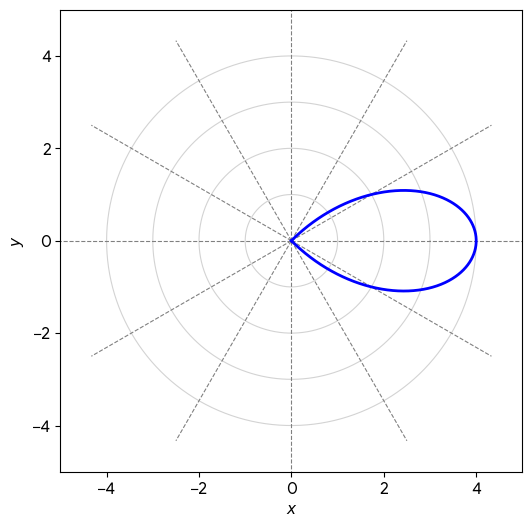
Which of the following describes the complete graph of \( r = 4\cos(2\theta) \) for all \( \theta \in [0, 2\pi] \)?
- A) A circle with radius 4
- B) A two-petal rose symmetric about the \( y \)-axis
- C) A four-petal rose with petals along both axes ✓
- D) A limaçon with an inner loop
Explanation: Choice C is correct. The equation has the form \( r = a\cos(n\theta) \) with \( n = 2 \) (even), which produces a rose curve with \( 2n = 4 \) petals. The four petals lie along both the positive and negative \( x \)- and \( y \)-axes. The graph shows one of those four petals; over the full domain \( [0, 2\pi] \), the remaining three are traced in the other quadrant pairs. Choice A is incorrect because a circle has constant \( r \); \( r = 4\cos(2\theta) \) varies with \( \theta \) and produces a rose. Choice B is incorrect because \( r = a\cos(n\theta) \) with even \( n \) produces \( 2n \) petals, not \( n \) petals; a two-petal rose would require a different form. Choice D is incorrect because a limaçon requires the form \( r = a + b\cos\theta \); the argument \( 2\theta \) and the absence of a constant term identify this as a rose.
Question 5. A polar curve has the equation \( r = 2 + 2\cos\theta \). Which of the following statements is supported by the equation?
- A) The curve is a rose curve because the equation contains a cosine term.
- B) The curve is symmetric about the \( y \)-axis because cosine is an even function.
- C) The curve is a circle because \( r \) equals a constant when \( \cos\theta = 0 \).
- D) The curve is a cardioid symmetric about the polar axis because it has the form \( r = a + a\cos\theta \). ✓
Explanation: Choice D is correct. The equation \( r = 2 + 2\cos\theta \) has the form \( r = a + b\cos\theta \) with \( a = b = 2 \). When \( a = b \), the limaçon becomes a cardioid, a heart-shaped curve that passes through the origin exactly once (when \( \theta = \pi \), \( r = 0 \)). Because the equation uses \( \cos\theta \) rather than \( \sin\theta \), the axis of symmetry is the polar axis (the positive \( x \)-axis). Both claims in Choice D are correct and supported by the equation's form. Choice A is incorrect because a rose curve requires the form \( r = a\cos(n\theta) \) with no added constant; the constant term 2 makes this a limaçon-family curve. Choice B is incorrect because within cardioid and limaçon forms, equations using \( \cos\theta \) are symmetric about the polar axis (the \( x \)-axis), while equations using \( \sin\theta \) are symmetric about the vertical axis; the cosine form here gives symmetry about the polar axis, not the \( y \)-axis. Choice C is incorrect because when \( \cos\theta = 0 \), \( r = 2 \) at two specific angles only, the curve is not a circle.