About This Drill
AP African American Studies: The Great Migration and Afro-Caribbean Migration (Drill 22) is a Multiple Choice practice drill covering Unit 3: The Practice of Freedom. It contains 5 original questions developed by Brian Stewart, a Barron's test prep author with over 20 years of tutoring experience.
Practice AP African American Studies questions on the Great Migration, push and pull factors, Jacob Lawrence’s Migration Series, Afro-Caribbean migration, and Marcus Garvey’s UNIA, with AP exam prep emphasis on source analysis and historical causation.
Passage
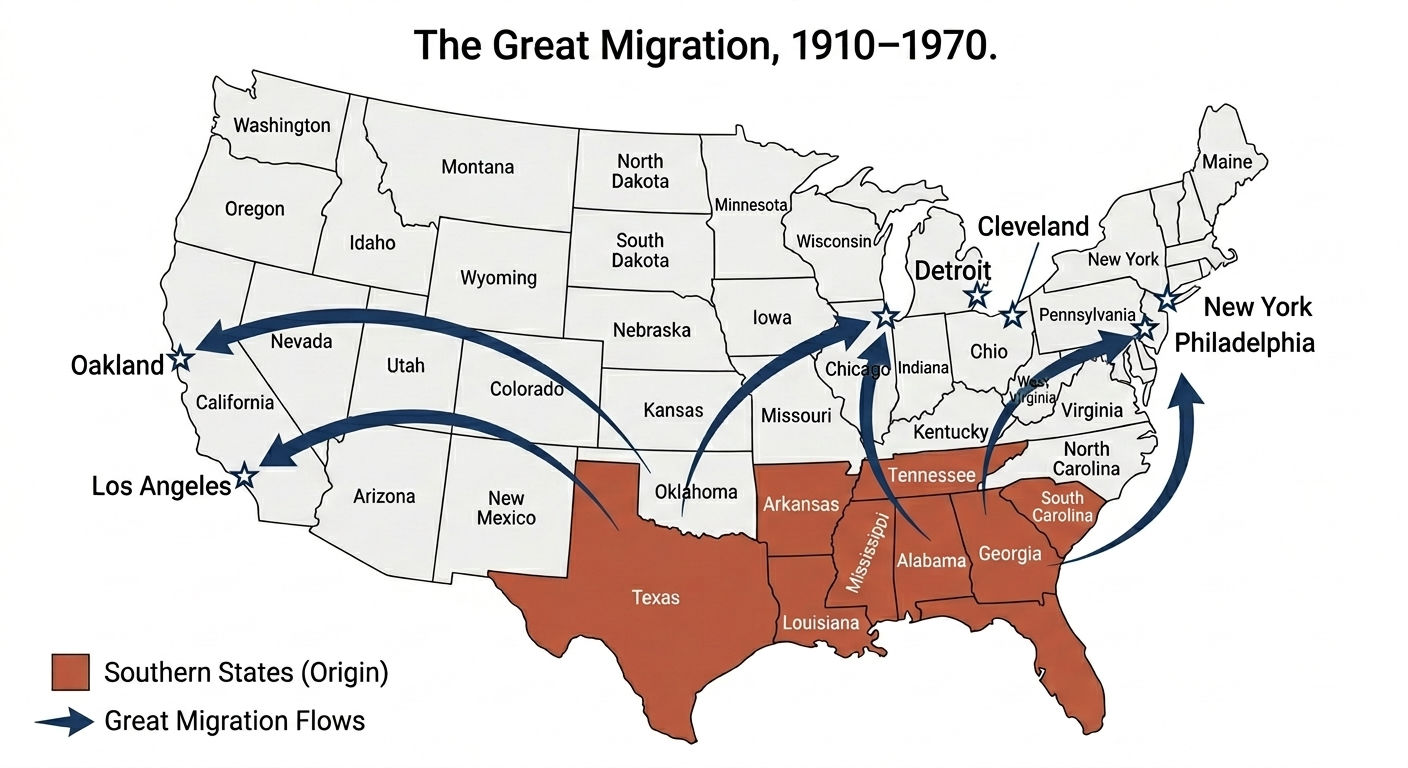 The image above shows a map of the United States with migration flow arrows representing the Great Migration, approximately 1910–1970. Southern states including Alabama, Mississippi, Georgia, South Carolina, Louisiana, and Texas are shaded in rust/terracotta. Bold arrows flow from the South toward Northern and Midwestern cities (Chicago, Detroit, New York, Philadelphia, Cleveland) and Western cities (Los Angeles, Oakland), marked with star icons.
Source: Educational map, “The Great Migration, 1910–1970,” freetestprep.com
The image above shows a map of the United States with migration flow arrows representing the Great Migration, approximately 1910–1970. Southern states including Alabama, Mississippi, Georgia, South Carolina, Louisiana, and Texas are shaded in rust/terracotta. Bold arrows flow from the South toward Northern and Midwestern cities (Chicago, Detroit, New York, Philadelphia, Cleveland) and Western cities (Los Angeles, Oakland), marked with star icons.
Source: Educational map, “The Great Migration, 1910–1970,” freetestprep.com Questions & Explanations
Question 1. Which of the following best describes a push factor that prompted African Americans to leave the South during the Great Migration?
- A) The expansion of industrial manufacturing jobs in Chicago and Detroit
- B) The enforcement of Jim Crow laws and the constant threat of racial violence ✓
- C) The relocation incentives offered by Northern city governments to attract Black workers
- D) The widespread availability of higher-wage agricultural work in the Midwest and West
Explanation: Push factors are conditions that drive people away from their place of origin. Jim Crow laws, disenfranchisement, and racial terror, including the pervasive threat of lynching, were among the most powerful forces compelling African Americans to leave the South. (A) is a pull factor, not a push factor, a reversal error students frequently make. (C) is historically inaccurate; Northern cities did not systematically offer relocation incentives to attract Black migrants. (D) is also inaccurate; higher-wage agricultural opportunities in the Midwest and West were not a widespread feature drawing Black Southerners away, industrial wage labor in cities was the pull, not farm work. (A) and (D) both describe conditions elsewhere that might attract migrants, while (C) invents a policy that did not exist; none describes conditions in the South that drove people out. [Skill 1A, Applying disciplinary knowledge: causation and push/pull factors]
Question 2. Based on the map, which of the following conclusions is best supported by the migration pattern depicted?
- A) African Americans primarily migrated to coastal cities to access international shipping employment in that era
- B) The Great Migration was geographically limited, with migrants settling only in the Midwest
- C) African Americans migrated to multiple destination regions, including both the Midwest and the West Coast ✓
- D) The Great Migration reversed an earlier pattern of Black movement into the Deep South
Explanation: The map shows arrows flowing from the South toward multiple destination regions, Midwestern cities like Chicago and Detroit, Northeastern cities like New York and Philadelphia, and Western cities like Los Angeles and Oakland. This multi-directional pattern is the defining visual feature of the source. (A) introduces coastal ports and economic motives not shown in the map. (B) contradicts the map directly, which shows Western destinations as well as Midwestern ones. (D) is historically inaccurate; the Great Migration flowed outward from the Deep South, not into it. The map-reading skill tested here is identifying the full range of destinations rather than incorrectly narrowing them to one region. [Skill 2A, Identify and describe a source’s claims]
Question 3. The Great Migration of African Americans from the South was similar to Afro-Caribbean migration to the United States in that both movements
- A) resulted in the formation of diasporic communities that maintained cultural connections to their places of origin ✓
- B) were primarily motivated by religious persecution rather than economic or political conditions
- C) were sponsored by the United States federal government as part of wartime labor programs
- D) were halted by the Immigration Act of 1924, which imposed strict national origin quotas
Explanation: Both the Great Migration and Afro-Caribbean migration produced culturally rich diasporic communities in Northern cities, most visibly in Harlem, where African Americans from the South and Caribbean immigrants from Jamaica, Barbados, and Trinidad built overlapping communities while maintaining cultural ties to their homelands. This is a core CED connection. (B) is inaccurate for both groups; economic conditions and racial oppression, not religious persecution, drove both migrations. (C) is false; neither migration was federally sponsored. (D) is a true-but-irrelevant distractor: the Immigration Act of 1924 did restrict Caribbean immigration, but it did not halt the Great Migration, which was internal movement within the United States entirely unaffected by immigration law. Students who know the Immigration Act was consequential may select this without thinking through which migration it actually applied to. [Skill 1C, Patterns and connections across contexts]
Question 4. Marcus Garvey’s Universal Negro Improvement Association (UNIA) drew much of its early leadership and membership base from
- A) formerly enslaved people in the rural South seeking land redistribution
- B) African American veterans of World War I organizing through the NAACP’s legal defense network
- C) Black college graduates affiliated with historically Black colleges and universities in the South
- D) Afro-Caribbean immigrants in Northern cities, particularly in New York’s Harlem neighborhood ✓
Explanation: Marcus Garvey was himself a Jamaican immigrant, and the UNIA’s early base was heavily drawn from Afro-Caribbean migrants living in Northern cities, particularly Harlem. His Pan-African vision of Black pride, economic self-sufficiency, and eventual return to Africa resonated strongly with Caribbean diaspora communities who felt doubly marginalized, by American racism and by their immigrant status. (A) confuses Garvey’s movement with Reconstruction-era land reform campaigns, a chronological error. (B) is a true-but-irrelevant distractor: Black WWI veterans were indeed politically active after 1919, but the UNIA’s distinctive base was Caribbean immigrant communities, not veterans operating through the NAACP. (C) conflates the UNIA with organizations like the Urban League, which had a more strongly college-educated, HBCU-affiliated professional base. [Skill 1A, Applying disciplinary knowledge: key organizations and their constituencies]
Question 5. A historian argues that the Great Migration fundamentally transformed American politics and culture in the twentieth century. Which of the following pieces of evidence most directly supports this claim?
- A) The establishment of the NAACP in 1909, which provided legal support for African Americans challenging discrimination
- B) The concentration of African Americans in Northern cities, which created new Black political constituencies and fueled the Harlem Renaissance ✓
- C) The passage of the Fair Housing Act of 1968, which prohibited racial discrimination in housing sales and rentals
- D) The growth of Black voter registration in Southern states following the Voting Rights Act of 1965
Explanation: The question asks for evidence that the Great Migration itself caused transformations in American politics and culture. (B) traces causally to the migration: the concentration of African Americans in Northern cities created large Black voting blocs in Chicago, Detroit, and New York that reshaped Democratic Party politics, and the convergence of Black artists and intellectuals in Harlem generated the Harlem Renaissance. Both effects flow directly from the geographic redistribution. (A) is a true-but-irrelevant distractor: the NAACP’s founding predates and is independent of the Great Migration; the organization’s importance does not answer a question about what the migration caused. (C) is also historically true but is a legislative response to discrimination, not a direct transformation caused by migration patterns. (D) refers to Southern voter registration gains that follow from the Voting Rights Act rather than from the northward Great Migration. Students who scan for familiar and important facts rather than tracing causation will confidently select (A), (C), or (D). [Skill 3B, Support a claim with specific evidence]