About This Drill
AP African American Studies: Contemporary Black Life (Drill 29) is a Multiple Choice practice drill covering Unit 4: Movements and Debates. It contains 5 original questions created by Brian Stewart, a Barron's test prep author with over 20 years of tutoring experience.
Practice AP African American Studies questions on contemporary Black life, including African American political representation, religious diversity, music from spirituals to hip-hop, and Black contributions to film and sports. These AP exam prep questions develop your skills in source analysis and applying disciplinary knowledge to recent history.
Passage
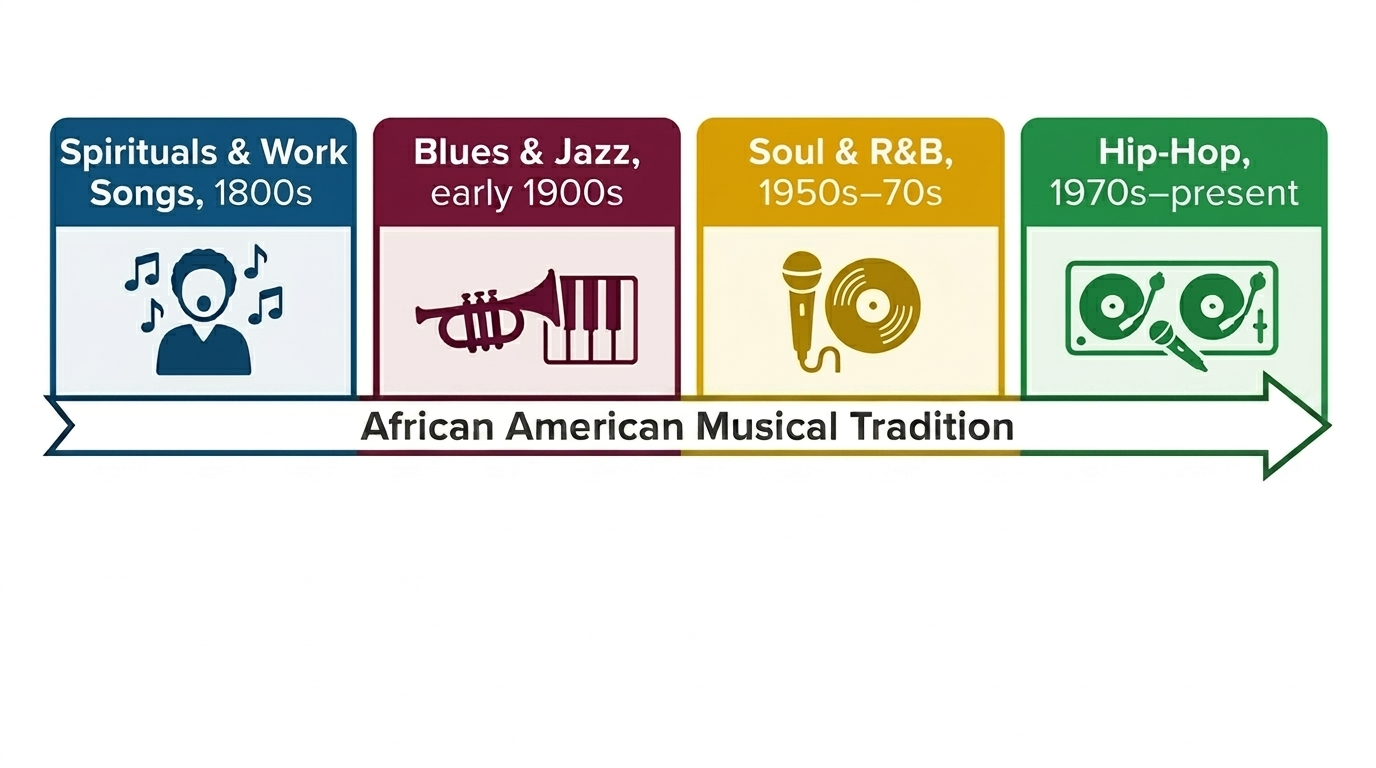
The infographic depicts four panels connected by a horizontal arrow labeled “African American Musical Tradition.” Panel 1 (“Spirituals & Work Songs, 1800s”) shows a figure singing with musical notes. Panel 2 (“Blues & Jazz, early 1900s”) shows a trumpet and piano keys. Panel 3 (“Soul & R&B, 1950s–70s”) shows a microphone and vinyl record. Panel 4 (“Hip-Hop, 1970s–present”) shows turntables and a microphone.
Source: Educational infographic, freetestprep.com, 2026
Questions & Explanations
Question 1. Which of the following best describes the central argument made by the infographic?
- A) African American music was primarily influenced by European musical traditions rather than African origins.
- B) African American musical traditions evolved continuously across historical periods, connecting earlier forms to later ones. ✓
- C) Spirituals and work songs were more culturally significant than hip-hop because they emerged under conditions of oppression.
- D) Each era of African American music represented a complete break from previous traditions.
Explanation: The horizontal connecting arrow labeled “African American Musical Tradition” is the key design element; it signals continuity rather than rupture across all four eras. The infographic argues that each new form (blues, soul, hip-hop) grew from and connected to what preceded it. (D) directly contradicts the connecting arrow’s meaning, rupture is precisely what the arrow refutes. (C) introduces a value judgment the infographic does not make; it treats all four eras as equal parts of a single tradition. (A) contradicts both the infographic and course content, which emphasizes African cultural roots in African American music. [Skill 2A, Identifying claims in a source]
Question 2. Which of the following best explains the significance of depicting all four musical eras under the label “African American Musical Tradition”?
- A) It implies that hip-hop represents a clear artistic decline from the deeper spiritual and moral depth of earlier African American musical forms within this musical lineage.
- B) It claims that spirituals and work songs were the most important genre because they appear first in the timeline.
- C) It suggests that African American music should be understood as a unified, evolving cultural inheritance rather than a series of unrelated genres. ✓
- D) It argues that African Americans invented all major American musical genres and therefore deserve legal copyright protections.
Explanation: The framing of the infographic, four distinct eras under one continuous arrow, argues for cultural inheritance and continuity, consistent with the AP AAS course theme of Creativity, Expression, and the Arts, which treats African American cultural production as a connected tradition rooted in the African diaspora. (D) overreads a copyright argument that simply is not in the image. (B) confuses sequence with hierarchy, appearing first in a timeline does not signal greater importance. (A) introduces a value judgment about decline that the neutral, celebratory tone of the infographic directly contradicts. [Skill 2B, Source perspective and purpose]
Question 3. African American religious life in the post-Civil Rights era is best characterized as similar to earlier periods in that it
- A) became less significant as African Americans gained greater economic and political representation during this period.
- B) shifted entirely away from church-based activism toward purely secular political organizing.
- C) continued to serve as a site of community organizing, social support, and resistance to racial inequality. ✓
- D) remained exclusively rooted in Protestant Christianity with no significant diversity.
Explanation: From the antebellum invisible church to the Civil Rights Movement’s use of Black churches as organizing centers, religious institutions have consistently played a central role in African American community life and resistance. This continuity extends into the contemporary period. (D) is false, contemporary African American religious life includes Islam, Yoruba-derived traditions, Catholicism, and more, reflecting significant diversity; it is historically true that Protestant Christianity was long dominant, making this a plausible distractor for students who know the earlier period but not the contemporary one. (B) creates a false either/or, religious and secular organizing have coexisted in every period. (A) confuses increased representation with declining institutional significance, both can grow simultaneously. [Skill 1C, Identifying patterns and continuity]
Question 4. The emergence of hip-hop in the South Bronx in the 1970s is best understood in the context of which of the following?
- A) Federal arts funding programs that provided resources for youth cultural expression in low-income neighborhoods
- B) The cultural influence of the Harlem Renaissance, which directly inspired a new generation of New York–based artists
- C) The national expansion of the organized Civil Rights Movement into Northern industrial cities during the early 1970s.
- D) Urban disinvestment, deindustrialization, and the concentration of poverty in Black and Latino communities following the postwar suburban exodus ✓
Explanation: Hip-hop emerged in the specific social conditions of the South Bronx: the destruction of neighborhoods by urban renewal and highway construction, “white flight” and disinvestment, the collapse of manufacturing jobs, and the concentration of poverty in Black and Latino communities. DJs, MCs, b-boys, and graffiti artists created a new culture in the absence of institutional resources. (C) is a genuine true-but-irrelevant distractor, the Civil Rights Movement did expand into Northern cities, but by the 1970s its organizational peak had passed; hip-hop’s emergence was shaped by socioeconomic collapse, not movement expansion. (B) is true as a broad cultural lineage but overstates the directness, hip-hop artists in the 1970s were responding to immediate material conditions, not primarily citing the Harlem Renaissance as inspiration. (A) is false, hip-hop arose largely without federal arts support, which is precisely one reason its origins in community self-creation are so significant. [Skill 1B, Explaining the context of a specific development]
Question 5. Which of the following best describes the significance of increased African American political representation in the decades following the Voting Rights Act of 1965?
- A) African American voters shifted overwhelmingly and permanently toward the Republican Party after the act.
- B) African American elected officials immediately eliminated racial economic disparities in the communities they represented.
- C) The election of African Americans to public office demonstrated that the Civil Rights Movement’s goals had been fully achieved.
- D) African American political representation increased substantially at local, state, and federal levels, though structural racial inequalities persisted. ✓
Explanation: Following the Voting Rights Act, the number of Black elected officials grew dramatically, from a few hundred in 1965 to thousands by the late 20th century, including mayors of major cities and members of Congress. However, increased representation did not automatically translate into the elimination of structural inequalities in wealth, housing, education, or criminal justice. (C) is the most tempting wrong answer: rising representation was real, and students who know that fact may be drawn to it, but the claim of full achievement of Civil Rights goals is false, not merely overstated. The question asks about significance, and (C) misdescribes the historical outcome itself. (B) overstates the immediate impact of elected officials on structural conditions. (A) is historically false, African Americans maintained strong Democratic voting patterns after 1965. [Skill 1A, Applying disciplinary knowledge]