About This Drill
AP African American Studies: Segregation, Civil Rights Origins, and Housing Discrimination (Drill 25) is a Multiple Choice practice drill covering Unit 4: Movements and Debates. It contains 5 original questions created by Brian Stewart, a Barron's test prep author with over 20 years of tutoring experience.
Test your knowledge of Jim Crow segregation, Brown v. Board of Education, and redlining with these AP African American Studies practice questions. Sharpen your AP exam prep skills with source-based questions on the Civil Rights Movement's legal and residential origins.
Passage
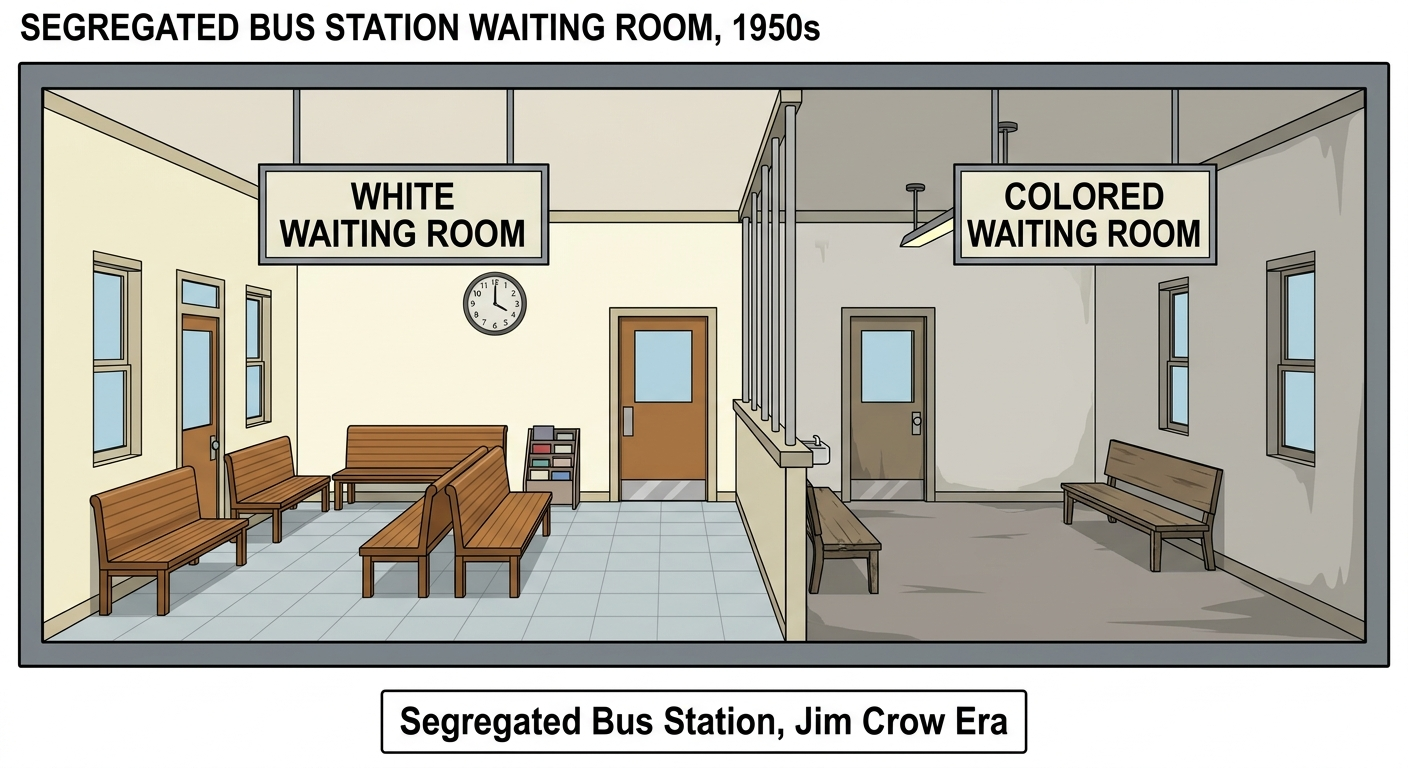 The image above shows a diagram of a segregated bus station waiting room from the Jim Crow era. The illustration depicts two sections divided by a physical partition: a larger, better-furnished section labeled “White Waiting Room” on the left, and a smaller, more sparsely appointed section labeled “Colored Waiting Room” on the right. The disparity in size and furnishings is visually evident. Both sections are accessed through separate doors.
Source: Illustration depicting a segregated bus station waiting room, Jim Crow era, mid-20th century United States.
Questions & Explanations
Question 1. The illustration of the segregated bus station waiting room most directly reflects which legal principle established by the Supreme Court?
- A) “Separate but equal,” as upheld in Plessy v. Ferguson (1896) ✓
- B) Federal preemption of state transportation law under the Commerce Clause
- C) The equal protection guarantee of the Fourteenth Amendment as applied to public facilities
- D) The “separate spheres” doctrine governing women’s participation in public life
Explanation: The physical division of the bus station into racially separate waiting rooms, with no pretense of actual equality in size or quality, is a direct product of Plessy v. Ferguson (1896), in which the Supreme Court upheld racial segregation under the doctrine of “separate but equal.” The illustration makes visually clear that the facilities were separate but manifestly unequal, which was the real-world norm under Jim Crow even when courts formally required equality. (B) is wrong because the Commerce Clause was later used to challenge segregation in interstate transportation, not to uphold it. (C) identifies the constitutional principle that would eventually be used to dismantle segregation, a true statement, but not what the source reflects. (D) refers to a 19th-century ideology about gender roles and is entirely unrelated. [Skill 2B, Source perspective and purpose]
Question 2. Which of the following best explains why Civil Rights activists specifically targeted segregated public transportation and facilities like the one depicted in the source?
- A) African American communities were more economically dependent on public transportation than white communities, making it a practical economic concern.
- B) The federal government had exclusive jurisdiction over interstate commerce, making transportation the easiest arena for legal challenges.
- C) Segregated public spaces enforced a visible daily hierarchy of racial subordination and offered high-visibility sites for organized protest. ✓
- D) Bus stations were among the few public spaces where federal civil rights law already applied, giving activists a legal foothold.
Explanation: Segregated public spaces, bus stations, lunch counters, buses, libraries, were targeted by Civil Rights activists because they enacted racial hierarchy in daily, visible, and humiliating ways. Challenging them served both a practical goal (desegregation) and a symbolic one (exposing the injustice of Jim Crow to national and international audiences). This is why the Montgomery Bus Boycott, Freedom Rides, and sit-in campaigns focused so heavily on transportation and public accommodations. (A) is historically true as a contributing factor but does not explain why these sites were chosen as targets for organized protest. (B) contains a true legal point but misidentifies the activists’ primary motivation. (D) is historically backward: federal civil rights law before 1964 did not broadly cover public accommodations, which is exactly why activists fought for the Civil Rights Act. [Skill 2B, Source perspective and purpose]
Question 3. The Supreme Court’s decision in Brown v. Board of Education (1954) represented a departure from earlier precedent primarily because it
- A) held that racially segregated public schools were inherently unequal and violated the Fourteenth Amendment’s equal protection clause ✓
- B) extended federal authority to regulate private businesses that served the public, including restaurants and hotels
- C) prohibited racial discrimination in voting registration procedures across all Southern states
- D) recognized African Americans as full citizens with the right to sue in federal court for the first time
Explanation: In Brown v. Board of Education, the Supreme Court repudiated the logic of Plessy v. Ferguson as applied to public education, holding that racially segregated schools were inherently unequal and violated the Fourteenth Amendment’s equal protection clause. Chief Justice Earl Warren’s unanimous opinion held that separate educational facilities generated a sense of inferiority in Black children that harmed their educational development. The Brown ruling rejected Plessy in the context of public schooling; subsequent cases extended that reasoning across other domains. (B) describes the Civil Rights Act of 1964, not Brown. (C) describes provisions related to the Voting Rights Act of 1965, a true statement about a different law and a classic “true but irrelevant” distractor. (D) is historically inaccurate; Black Americans had been recognized as citizens under the Fourteenth Amendment since 1868. [Skill 1A, Applying disciplinary knowledge]
Question 4. Redlining, as practiced by the Home Owners’ Loan Corporation (HOLC) and private lenders in the mid-20th century, most directly affected African Americans by
- A) prohibiting them from purchasing homes in federally designated flood zones
- B) systematically denying mortgage loans and investment in predominantly Black neighborhoods, limiting wealth accumulation ✓
- C) requiring Black homebuyers to pay higher property taxes than white homebuyers in the same districts
- D) forcing African American veterans to purchase homes only through segregated Veterans Administration offices in the setting described
Explanation: Redlining was the practice of designating predominantly Black neighborhoods as high-risk on color-coded maps and systematically refusing to extend mortgage loans or insurance to residents of those areas. This locked Black families out of homeownership, the primary mechanism of middle-class wealth accumulation in postwar America, and trapped existing residents in neighborhoods denied private investment and public services, compounding generational wealth inequality. (A) describes a different regulatory practice unrelated to race-based discrimination. (C) is incorrect; redlining worked through credit denial, not tax policy. (D) contains a historical grain of truth, the GI Bill was administered unequally along racial lines, but mischaracterizes how redlining specifically functioned. [Skill 1A, Applying disciplinary knowledge]
Question 5. Which of the following most accurately characterizes the relationship between residential segregation produced by redlining and the subsequent development of the Civil Rights Movement?
- A) Redlining accelerated the Civil Rights Movement by triggering immediate federal intervention to correct housing discrimination.
- B) The concentration of African Americans in Northern cities rapidly translated into Black electoral majorities that could pass civil rights legislation.
- C) Redlining was primarily a Southern phenomenon and its effects were therefore limited to the regions where the Civil Rights Movement was most active.
- D) Residential segregation concentrated Black communities in urban neighborhoods where churches, civic associations, and organizations became bases for Civil Rights organizing. ✓
Explanation: Residential segregation, though economically damaging, concentrated African Americans in urban neighborhoods where Black churches, newspapers, NAACP branches, and civic associations formed dense institutional networks. These institutions became the organizational infrastructure of the Civil Rights Movement, not because segregation was beneficial, but because Black communities built enduring institutions within the conditions imposed on them. (A) is a plausible-sounding misconception: the federal response to housing discrimination was in fact slow and incomplete; meaningful federal action did not arrive until the Fair Housing Act of 1968, and enforcement remained weak for decades after. (B) is a misleading half-truth: African Americans gained political influence in Northern cities but rarely constituted majorities sufficient to pass federal legislation unilaterally. (C) is factually wrong, redlining was a national policy practiced extensively in Northern and Midwestern cities, not limited to the South. [Skill 1C, Patterns, continuity, and change]