About This Drill
AP African American Studies: The New Negro Movement and the Harlem Renaissance (Drill 20) is a Multiple Choice practice drill covering Unit 3: The Practice of Freedom. It contains 5 original questions created by Brian Stewart, a Barron's test prep author with over 20 years of tutoring experience.
Test your knowledge of the New Negro Movement, Harlem Renaissance figures, and cultural expression with these AP African American Studies practice questions focused on AP exam prep for Unit 3.
Passage
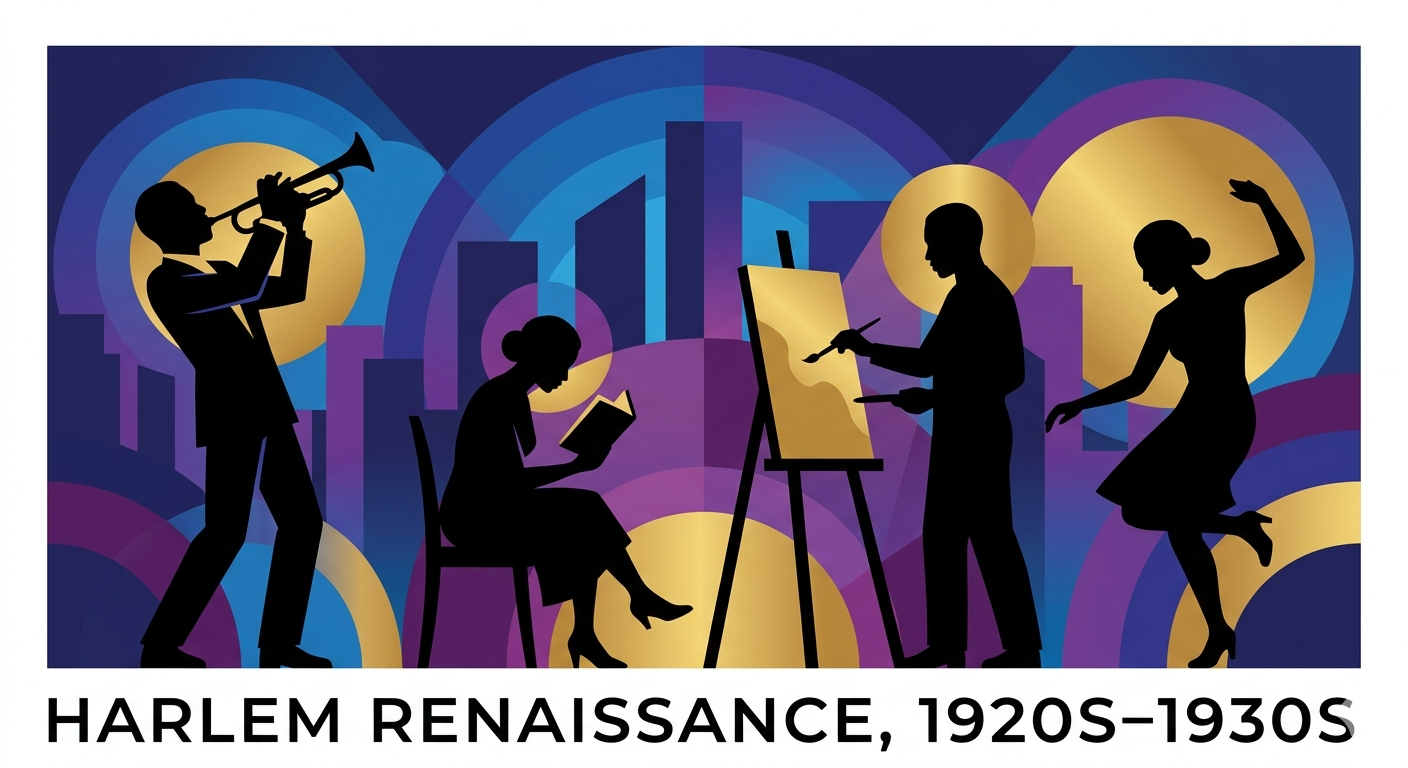
The illustration above was created in the style of Harlem Renaissance visual art, inspired by the work of Aaron Douglas. It depicts four stylized Black figures, a trumpet player, a reader, a painter, and a dancer, set against layered geometric arcs suggesting a city skyline at night. The image uses bold silhouettes and flat color fields in deep blues, purples, and gold. A caption at the bottom reads: “Harlem Renaissance, 1920s–1930s.”
Questions & Explanations
Question 1. Which of the following best describes the visual style of the illustration as it relates to the Harlem Renaissance?
- A) It blends realism with symbolic imagery to emphasize individual portrait identity over collective expression
- B) It reflects the European Impressionist influence that defined most African American art of the period
- C) It depicts pastoral rural Southern life as a nostalgic counterpoint to urban Harlem nightlife
- D) It employs bold silhouettes, geometric forms, and layered color, the visual vocabulary associated with artists like Aaron Douglas ✓
Explanation: Aaron Douglas was the leading visual artist of the Harlem Renaissance, known for bold flat silhouettes, geometric abstraction, and richly layered colors influenced by Art Deco and African design motifs. The description of the illustration matches this style directly. (A) is more plausible than simpler alternatives, blending realism and symbolism describes some artistic traditions, but it mischaracterizes this image’s fully stylized, non-realistic composition and its emphasis on collective figures rather than individual identity. (B) is a plausible trap for students who associate European movements with American art history generally, but Harlem Renaissance visual art deliberately drew on African and African American aesthetics rather than French Impressionism; this is the “historically true but not applicable here” distractor. (C) contradicts the cityscape composition directly; the urban skyline signals Northern life, not rural Southern settings. [Skill 2B, Source perspective and purpose]
Question 2. The inclusion of four figures representing music, literature, visual art, and dance in the illustration most directly reflects which central idea of the Harlem Renaissance?
- A) The belief that economic self-sufficiency in Northern cities was the primary goal of Black cultural life
- B) The conviction that Black cultural expression across multiple arts was central to racial identity and political liberation ✓
- C) The argument that Black artists should document the Great Migration through representational painting and photography according to this line of historical interpretation
- D) The insistence that African American artists should master European classical forms to gain mainstream acceptance
Explanation: The Harlem Renaissance positioned Black artistic production, across literature, visual art, music, and performance, as an assertion of Black identity, dignity, and political agency. The four figures symbolize this multidisciplinary cultural energy. (A) describes a more Washingtonian economic focus; the Renaissance’s leaders rejected the idea that economic accommodation alone would achieve full humanity. (C) is a carefully constructed distractor, documentary art was genuinely part of some Harlem Renaissance work, but it narrows the movement’s purpose too specifically to migration documentation and misses the broader assertion of cultural identity. This is the “partial truth” trap: the Great Migration was a real context for the Renaissance, but this answer reduces a multidimensional cultural movement to one documentary function. (D) reverses the Renaissance’s actual direction: figures like Langston Hughes explicitly celebrated vernacular Black culture rather than imitating European forms. [Skill 2A, Identifying and describing a source’s main claim]
Question 3. Langston Hughes’s essay “The Negro Artist and the Racial Mountain” (1926) argued that Black artists should
- A) focus exclusively on depicting the experience of the rural South rather than the urban life they now inhabited in cities like Harlem
- B) avoid all political and racial themes entirely in order to win broader white audiences and achieve greater commercial publishing success within the cultural debate described here.
- C) embrace Black vernacular culture, including jazz, blues, and everyday Black life, as the authentic foundation of African American artistic expression ✓
- D) demonstrate intellectual equality with white artists by achieving mastery of European classical literary and musical forms
Explanation: Hughes’s landmark essay was a manifesto for cultural authenticity. He argued that the drive to imitate white artistic standards represented a kind of racial self-denial, a “racial mountain” to climb away from Blackness, and called on Black artists to embrace jazz, blues, and everyday life as genuinely beautiful artistic subjects. (A) is a scope error, while Hughes honored Southern folk roots, his own poetry celebrated urban Harlem life extensively; the essay does not call for a return to Southern subjects. (B) inverts Hughes’s position; he believed honest Black artistic expression was inherently political and that commercial approval from white audiences was not the measure of artistic worth. (D) describes the position Hughes was arguing against, the internalized preference for European artistic standards that he called the “racial mountain” itself. (D) is the most important trap: European artistic mastery was valued by some Harlem Renaissance figures like Countee Cullen, so students with partial knowledge may think it represents the movement’s consensus. [Skill 2B, Source perspective and purpose]
Question 4. Which of the following best explains why the Harlem Renaissance is considered both a cultural and a political movement?
- A) Harlem Renaissance writers and artists produced work that exclusively and directly lobbied for specific federal statutes, such as anti-lynching laws, with no purely aesthetic output.
- B) By asserting Black aesthetic achievement and intellectual depth, Harlem Renaissance artists challenged the racial ideologies used to justify segregation and disenfranchisement, even when their work was not explicitly political in content ✓
- C) The movement was organized and funded by the NAACP and Urban League, whose editorial control over publications like The Crisis and Opportunity shaped the movement’s political direction
- D) The Harlem Renaissance replaced political organizing as the primary strategy of African Americans in the 1920s, shifting energy away from legal and legislative campaigns
Explanation: The Harlem Renaissance challenged the intellectual premises of white supremacy, that Black people lacked artistic and intellectual capacity, through the production of literature, art, and music. Cultural assertion is political action even without explicit policy content. (A) overstates the case; most Harlem Renaissance work was not direct policy advocacy, and framing it that way misunderstands how cultural movements function politically. (C) is the most carefully constructed distractor: the NAACP and Urban League did provide funding and publication venues for Renaissance figures, The Crisis under Du Bois and Opportunity under Charles S. Johnson were genuinely important platforms, but artistic direction and thematic development remained decentralized and artist-driven. Organizational support does not equal organizational control. Students who know these institutional connections will find (C) highly plausible and must distinguish between support and control. (D) creates a false opposition; the Renaissance coexisted with and reinforced political organizing rather than replacing it. [Skill 3B, Supporting a claim with evidence]
Question 5. Zora Neale Hurston’s work during the Harlem Renaissance is best known for
- A) its explicit calls for armed resistance against racial violence, in the tradition of Claude McKay’s wartime poetry
- B) its focus on middle-class urban African Americans navigating the challenges of integration in Northern cities
- C) its anthropological and literary celebration of Black Southern folk culture, vernacular speech, and community life ✓
- D) its rejection of African American vernacular traditions in favor of assimilation into mainstream American literary forms
Explanation: Hurston was both a novelist and anthropologist who studied Black Southern folklore under Franz Boas. Her novel Their Eyes Were Watching God (1937) and folklore collection Mules and Men (1935) celebrated the richness of Black vernacular life in the rural South. (A) conflates Hurston with Claude McKay, whose poem “If We Must Die” (1919) is a famous call to resistance; Hurston’s work is culturally celebratory rather than militantly political, students who know McKay’s work but blur the distinct voices of the movement will choose this. (B) describes a different strand of African American literature, Hurston’s world was rural Florida and the Deep South, not Northern middle-class urban life. (D) is the opposite of Hurston’s actual contribution; her celebration of vernacular speech deliberately refused assimilation and was controversial among some Harlem Renaissance peers, including Richard Wright, precisely for that reason. [Skill 1A, Applying disciplinary knowledge to explain a development]