About This Drill
AP African American Studies: West African Empires: Mali and Trade Networks (Drill 5) is a Multiple Choice practice drill covering Unit 1: Origins of the African Diaspora. It contains 5 original questions created by Brian Stewart, a Barron's test prep author with over 20 years of tutoring experience.
Test your knowledge of the Mali Empire, Mansa Musa, trans-Saharan trade routes, and West Africa’s role in global exchange networks with these AP African American Studies practice questions. Ideal AP exam prep for Unit 1 source analysis and disciplinary knowledge skills.
Passage
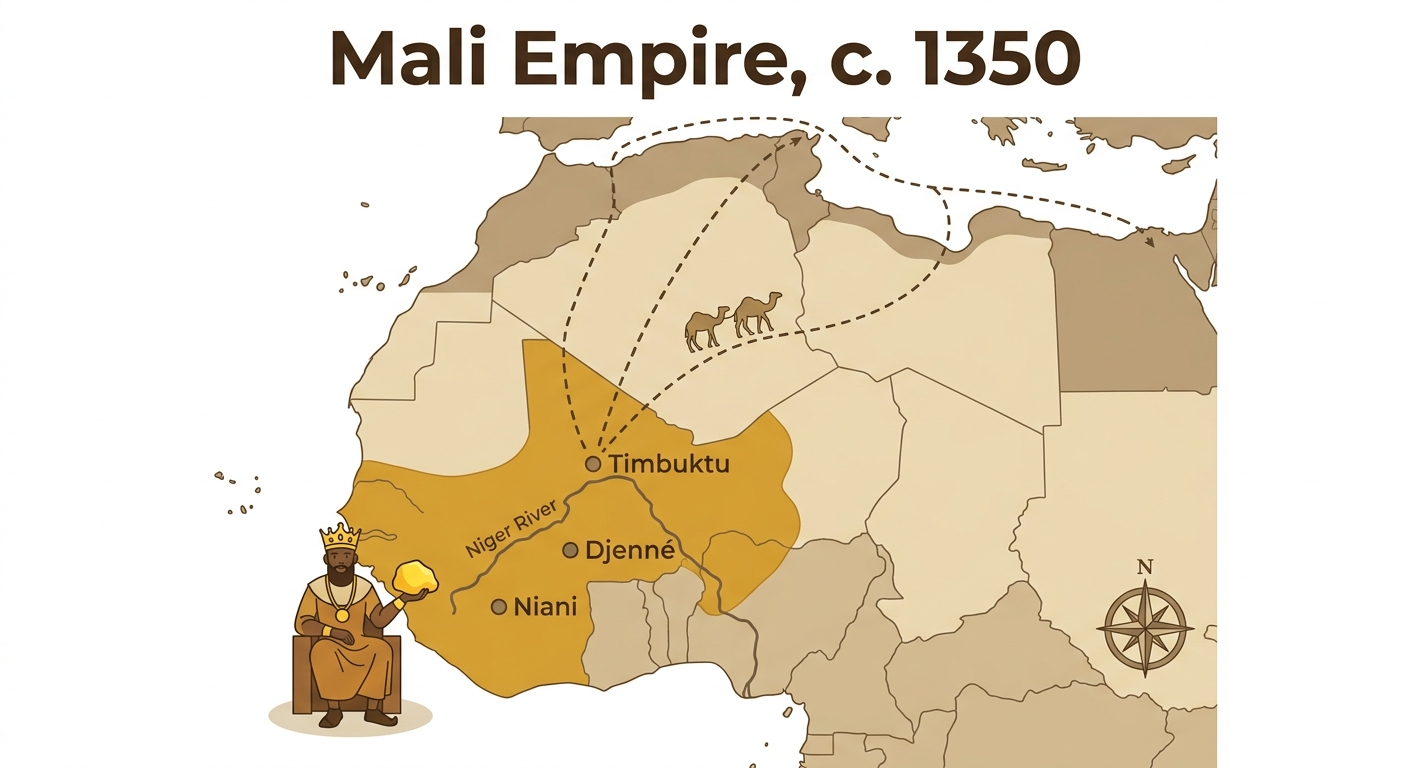
The image above depicts a portion of the Catalan Atlas (1375), a medieval European map created by Abraham Cresques. In the section depicting West Africa, a large enthroned African king is shown at the center of a landmass labeled “Musa Mali.” The figure wears a gold crown and holds a large gold orb in one hand and a gold scepter in the other. To his left, a camel caravan travels northward across the Sahara. The surrounding text of the atlas describes the ruler as “the richest and most noble king in all the land” due to the abundance of gold in his territory.
— Source: Abraham Cresques, Catalan Atlas (detail), 1375
Questions & Explanations
Question 1. The depiction of Mansa Musa in the Catalan Atlas most directly reflects which of the following?
- A) European scholarly interest in accurately documenting African religious practices
- B) European awareness of West Africa’s wealth and its significance in global trade networks ✓
- C) An effort by African rulers to project power through diplomatic missions to European courts
- D) The influence of Islamic pilgrimage culture on European cartographic traditions
Explanation: The Catalan Atlas was produced by a European cartographer and depicted Mansa Musa as extraordinarily wealthy, indicating that European geographic knowledge included West African kingdoms as major centers of wealth and commerce. (A) misidentifies the focus; the image emphasizes material wealth, not religious practice. (C) reverses the source’s direction, the atlas was a European production, not something transmitted by African rulers. (D) is historically connected, Mansa Musa’s 1324 hajj did spread knowledge of Mali’s wealth, but the atlas reflects European cartographic practice, not Islamic pilgrimage culture as a structural influence on how the map was made. [Skill 2B, Source perspective and purpose]
Question 2. The camel caravan depicted traveling northward in the Catalan Atlas most directly illustrates which of the following historical developments?
- A) The spread of Islam from North Africa into the Mali Empire during the 9th century
- B) The trans-Saharan trade networks that connected West Africa to North Africa and beyond ✓
- C) The military campaigns that Mansa Musa used to expand Mali’s territory northward
- D) The migration of West African peoples into the Mediterranean world during the 14th century
Explanation: The northward-traveling camel caravan is a direct visual reference to the trans-Saharan trade routes that carried gold, salt, and other goods between West Africa and North Africa, linking West African economies to Mediterranean and Middle Eastern exchange networks. (A) describes a real historical process but is not what the image depicts, trade, not religious transmission, is shown. (C) is false; Mansa Musa’s reign is not characterized by northward military expansion. (D) conflates trade with migration; the caravan represents commercial exchange, not population movement. [Skill 2C, Evaluating the significance of a source]
Question 3. The Mali Empire’s prosperity in the 14th century was primarily built on which of the following foundations?
- A) Control of Atlantic coastal fishing and trade with European maritime powers
- B) Agricultural surpluses generated by a large enslaved labor force on plantations
- C) Command of gold-producing regions and trans-Saharan trade in gold and salt ✓
- D) Tribute payments extracted from the conquest of neighboring kingdoms
Explanation: Mali’s wealth rested on its control of gold-producing areas, particularly the Bambuk and Bure goldfields, and its command of the trans-Saharan trade, with gold moving north and salt moving south. (A) is false for this era; Mali had no Atlantic trade presence. (B) imports a framework from a different historical context entirely, plantation agriculture with enslaved labor describes the Americas centuries later, not 14th-century West Africa. (D) contains a kernel of truth (some neighboring peoples paid tribute to Mali), but the empire’s prosperity derived from trade wealth, not primarily from tribute extraction. [Skill 1A, Applying disciplinary knowledge]
Question 4. The role of griots in the Mali Empire was most similar to which of the following in another cultural tradition?
- A) Islamic scholars at the University of Timbuktu who preserved written religious texts
- B) West African market traders who maintained oral records of commercial transactions
- C) European monks in medieval monasteries who copied and preserved written manuscripts
- D) Oral historians and storytellers in other African societies who preserved community knowledge across generations ✓
Explanation: Griots were specialized oral historians, genealogists, and cultural custodians who preserved historical knowledge, royal lineages, and cultural traditions through memory and performance. Their closest parallel is other oral historian and storyteller traditions in African societies, the role was defined by oral transmission of community and historical knowledge. (A) describes a real Timbuktu institution but conflates written Islamic scholarship with the griot’s oral tradition, which were distinct practices. (B) reduces the griot’s role to commercial record-keeping, missing its cultural, political, and historical dimensions. (C) draws a surface-level parallel, like monks, griots preserved knowledge across generations, but monks relied on written manuscripts while griots embodied an oral tradition. The method of preservation is fundamental to both roles, and on that point the comparison breaks down. [Skill 2C, Evaluating the significance of a source]
Question 5. Which of the following best describes a change in European perceptions of West African kingdoms between the period of early trans-Saharan contact (9th–14th centuries) and the period of the transatlantic slave trade (15th–18th centuries)?
- A) Europeans moved from viewing West African rulers as trading partners and wealthy sovereigns to viewing Africans primarily through a racial hierarchy that justified enslavement ✓
- B) Europeans lost all knowledge of West African geography and civilization after the Catalan Atlas was produced in 1375
- C) West African kingdoms grew weaker after Mansa Musa’s reign, making them straightforwardly vulnerable to European military conquest
- D) European cartographers stopped depicting African rulers in maps once the transatlantic slave trade began
Explanation: Medieval European sources, including the Catalan Atlas, depicted Mansa Musa as a powerful and wealthy sovereign. Over the following centuries, as the transatlantic slave trade developed and ideologies of racial hierarchy were constructed to justify it, European representations of Africans shifted dramatically toward dehumanizing frameworks. (B) is factually false, European geographic knowledge of Africa continued and expanded through this period. (C) contains real history (Mali did decline after Mansa Musa’s reign, eventually giving way to Songhai), but that trajectory did not straightforwardly produce European conquest of West Africa, and the question asks about a change in European perceptions, not African political history. (D) is false, African rulers continued to appear in European maps and documents well into the slave trade era. [Skill 3B, Supporting a claim with evidence]