About This Drill
AP Precalculus: Sinusoidal Functions: Amplitude, Period, Midline (Drill 1) is a Math practice drill covering Sinusoidal Functions: Amplitude, Period, Midline. It contains 5 original questions developed by Brian Stewart, a Barron's test prep author with over 20 years of tutoring experience.
Test your understanding of the core properties of sinusoidal functions, amplitude, period, and midline, the most heavily tested topic on the AP® Precalculus exam. Practice identifying these features from graphs, equations, and context, and master the LCM method for finding the period of sums of sinusoidal functions.
Questions & Explanations
Question 1. A sinusoidal function f has a minimum value of −3 and a maximum value of 11. What are the amplitude and midline of f?
- A) Amplitude = 14, midline y = 4
- B) Amplitude = 7, midline y = 3
- C) Amplitude = 7, midline y = 4 ✓
- D) Amplitude = 8, midline y = 4
Explanation: Choice C is correct. Amplitude = (max − min) / 2 = (11 − (−3)) / 2 = 14 / 2 = 7. Midline = (max + min) / 2 = (11 + (−3)) / 2 = 8 / 2 = 4, so the midline is y = 4. Choice A is incorrect because 14 is the full range (max − min), not the amplitude, amplitude is half the range. Choice B is incorrect because the midline uses (max + min) / 2 = (11 + (−3)) / 2 = 4, not (max − min) / 2; the midline is y = 4, not y = 3. Choice D is incorrect because 8 results from computing 11 − 3 = 8 without dividing by 2; the amplitude is 7, not 8.
Question 2. The function \( g(x) = 3\sin(2x) + 5\cos(4x) \) is the sum of two sinusoidal functions. What is the period of \( g(x) \)?
- A) \( \pi \) ✓
- B) \( \dfrac{\pi}{2} \)
- C) \( 2\pi \)
- D) \( \dfrac{\pi}{4} \)
Explanation: Choice A is correct. The period of \( \sin(2x) \) is \( \dfrac{2\pi}{2} = \pi \), and the period of \( \cos(4x) \) is \( \dfrac{2\pi}{4} = \dfrac{\pi}{2} \). The period of a sum of sinusoidal functions is the smallest positive value for which both components complete full cycles, that is, the least common multiple (LCM) of the individual periods. \( \text{LCM}\!\left(\pi,\, \dfrac{\pi}{2}\right) = \pi \), since \( \pi = 2 \times \dfrac{\pi}{2} \). Choice B is incorrect because \( \dfrac{\pi}{2} \) is only the period of \( \cos(4x) \); the full function does not repeat until both components have completed full cycles. Choice C is incorrect because \( 2\pi \) would be the period of \( \sin(x) \) or \( \cos(x) \) with no coefficient, the angular frequency must be used to find the period. Choice D is incorrect because periods cannot be found by adding or multiplying angular frequencies.
Question 3. A sinusoidal function f is shown in the graph below. Each grid square represents 1 unit.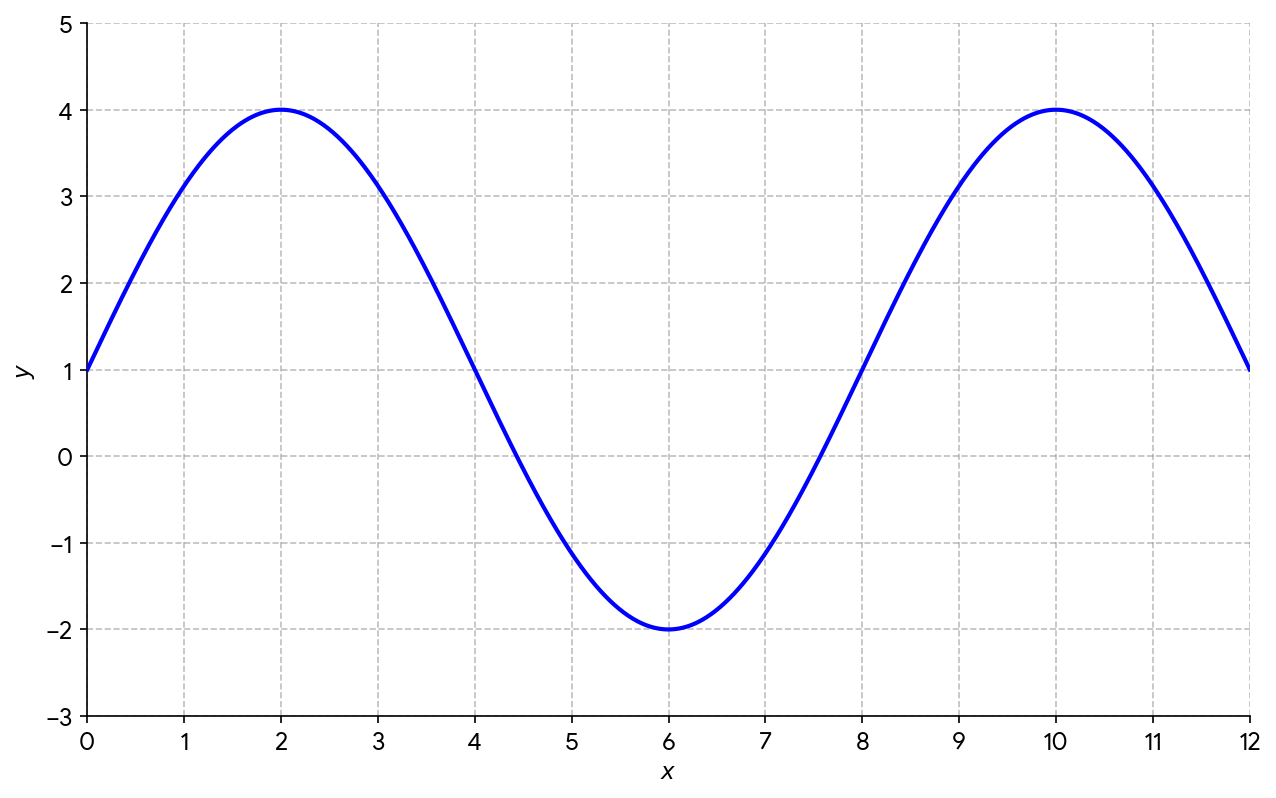
What is the period of f?
- A) 3
- B) 4
- C) 6
- D) 8 ✓
Explanation: Choice D is correct. The period of a sinusoidal function is the horizontal distance from one peak to the next. Reading the graph, peaks occur at x = 2 and x = 10, so the period is 10 − 2 = 8. Choice A is incorrect because 3 is the amplitude, the vertical distance from the midline (y = 1) to a peak (y = 4), not the horizontal width of one cycle. Choice B is incorrect because 4 is the distance from a peak to the next midline crossing (one quarter-period), not a full period. Choice C is incorrect because 6 is the distance from the first peak (x = 2) to the trough (x = 6), which is only a half-period.
Question 4. Which of the following equations represents a sinusoidal function with amplitude 4, period \( \pi \), and midline \( y = -2 \)?
- A) \( f(x) = 4\sin(\pi x) - 2 \)
- B) \( f(x) = 4\sin(2x) - 2 \) ✓
- C) \( f(x) = 2\sin(4x) - 2 \)
- D) \( f(x) = 4\sin(2x) + 2 \)
Explanation: Choice B is correct. For \( f(x) = A\sin(Bx) + k \), the amplitude is \( |A| \), the period is \( \dfrac{2\pi}{B} \), and the midline is \( y = k \). In Choice B, \( A = 4 \) (amplitude = 4 ✓), \( B = 2 \) (period = \( \dfrac{2\pi}{2} = \pi \) ✓), and \( k = -2 \) (midline \( y = -2 \) ✓). Choice A is incorrect because \( 4\sin(\pi x) - 2 \) has period \( \dfrac{2\pi}{\pi} = 2 \), not \( \pi \). Choice C is incorrect because \( 2\sin(4x) - 2 \) has amplitude 2, not 4. Choice D is incorrect because \( 4\sin(2x) + 2 \) has midline \( y = 2 \), not \( y = -2 \).
Question 5. A buoy bobs up and down in the ocean. Its height h (in feet above the ocean floor) is modeled by a sinusoidal function of time t in seconds. The buoy reaches a maximum height of 14 feet at t = 2 and the next minimum height of 6 feet at t = 8. What is the period of the function?
- A) 6 seconds
- B) 8 seconds
- C) 12 seconds ✓
- D) 16 seconds
Explanation: Choice C is correct. The time from a maximum to the next minimum represents half of one full period. Here, the maximum occurs at t = 2 and the next minimum at t = 8, so the half-period is 8 − 2 = 6 seconds. The full period is therefore 2 × 6 = 12 seconds. Choice A is incorrect because 6 seconds is only the half-period, the time from the maximum to the next minimum. Choice B is incorrect because 8 is the time value at which the minimum occurs, not the period. Choice D is incorrect because 16 = 2 × 8 doubles the time at the minimum rather than doubling the half-period; this is not a valid method for finding the period.