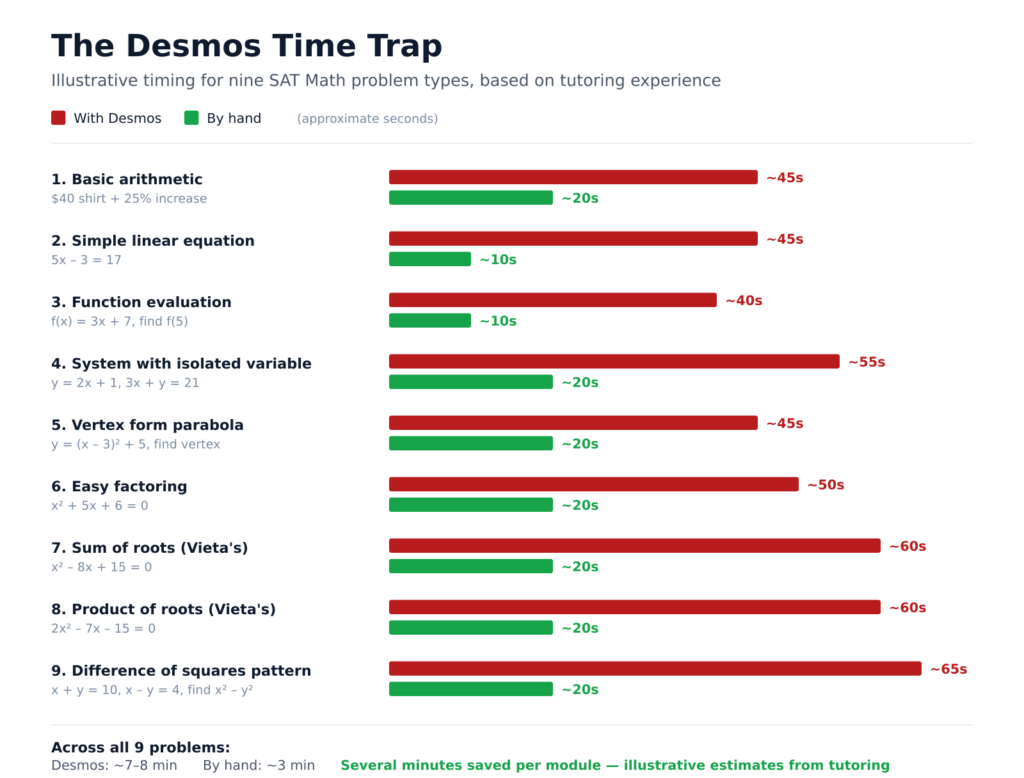
Students are losing real time on the Digital SAT by typing problems like 0.25 × 40 + 40 into Desmos.
That is the calculation for a $40 shirt after a 25% increase: take 25% of $40 (which is $10), then add it back to the $40 to get $50. Ten seconds of mental math. Yet I see students consistently open Desmos for problems exactly like this one, type the whole expression in, read the result, and lose 30 to 45 seconds they did not have to lose.
That habit, defaulting to Desmos for problems you could solve in your head, is one of the biggest patterns I see right now in students prepping for the Digital SAT. Desmos is built into the Bluebook testing app, every YouTube tutorial treats it like a cheat code, and students respond by pumping every problem through it. The result: they finish Module 1 with no time to spare, then run out of clock on the harder questions in Module 2.
After 20+ years and 30,000+ hours of tutoring this test, I can tell you the students who hit 750+ in math do the opposite. They use Desmos for the handful of questions where it is genuinely faster, and they trust their algebra the rest of the time. Students stuck in the 600s often have the same math knowledge. What they lack is the discipline to put the calculator down when they don’t need it. (For topic-organized practice on the underlying algebra, the free SAT Math drills here on the site cover every question type the test asks.)
To be clear: Desmos is powerful, and every student should know how to use it well. I have written a separate guide to advanced Desmos techniques for the Digital SAT for exactly that reason. The mistake is not using Desmos. The mistake is using it when a ten-second hand method is sitting right there.
Here’s the rule I drill into my students: if you can solve it in 30 seconds or so without Desmos, don’t open Desmos. The time it takes to type the problem in, set up the variables, and read the result is real, and it adds up over the course of a module. That time is better spent on the harder questions at the back end of Module 2.
If mental math leads to careless mistakes for you, write the steps out on scratch paper instead. The point is to skip Desmos when the algebra is straightforward, not to do everything in your head.
The bigger point is not to ban Desmos. It is to know when your hand method is clearly faster, and to default to it in those cases.
Below are nine specific situations where Desmos is usually slower than doing the work by hand. Each one is a problem type I see students consistently lose time on.
One note on the chart at the top of this post: actual timing depends on the student and the specific question. Those bars reflect what I typically see in tutoring, not measured data. The point is the relative gap, not the exact seconds.
1. Basic Arithmetic and Percentages
If a question says a $40 shirt goes up 25%, you should not be opening Desmos. Twenty-five percent is one fourth. One fourth of $40 is $10. The new price is $50. That is ten seconds of mental math.
Now compare that to typing the question into Desmos, which easily costs you half a minute or more by the time you set it up and read the result. Do that on five or six “easy” questions across both modules and you have eaten into time you could have spent on the hard ones.
2. Simple Linear Equations
A problem like 5x – 3 = 17 does not need a graphing calculator. Add 3 to both sides, divide by 5, x = 4. Done in 10 seconds.
If you find yourself reaching for Desmos on every linear equation, that usually means the underlying algebra needs more reps. The SAT often rewards basic algebra fluency, and Desmos doesn’t fix shaky fundamentals. Practice does. (Linear equations drills here if you want to put in the reps.)
3. Function Evaluation
If f(x) = 3x + 7, what is f(5)?
You substitute. f(5) = 3(5) + 7 = 22. That’s it. Graphing the function and reading off the y-value at x = 5 is almost always slower than substitution, no matter how comfortable you are with Desmos.
When students do reach for Desmos on a problem like this, it is usually because graphing the function feels safer than trusting the arithmetic. The instinct is understandable, and it is one of the fastest ways to fall behind on a Digital SAT math module.
4. Systems Where One Variable Is Already Isolated
This one trips students up because they hear “system of equations” and reach for Desmos automatically. But look at this setup:
y = 2x + 1
3x + y = 21
The first equation is already solved for y. Substitute it into the second equation: 3x + (2x + 1) = 21. Combine to get 5x = 20, so x = 4. Twenty seconds of work.
Desmos can do this. It will also take you noticeably longer than substitution by the time you type both equations in correctly and click on the intersection point. Substitution exists because it is fast when one variable is sitting there waiting to be plugged in. (Drill systems of equations here if substitution doesn’t feel automatic yet.)
If substitution and function evaluation are not automatic for you, that is exactly the kind of weakness that slows students down on the Digital SAT. The free SAT Math drills on this site are organized by topic so you can target those specific gaps directly.
5. Equations Already in Useful Form
If the question gives you y = (x – 3)² + 5 and asks for the x-coordinate of the vertex, the answer is 3. You read it off the equation. Vertex form gives you the vertex.
Same idea for slope-intercept form when they ask for slope or y-intercept, point-slope form when they give you a point on the line, and standard form for a circle when they ask for the center or radius. The College Board often hands you the equation in exactly the form that answers the question. Students who immediately graph it in Desmos are ignoring the shortcut built into the equation.
6. Easy Factoring
x² + 5x + 6 = 0 factors to (x + 3)(x + 2) = 0. The roots are -3 and -2. If you can see that two numbers multiply to 6 and add to 5, you have the answer in about 15 seconds.
Some students tell me they are slow at factoring, so Desmos is faster for them. My answer is the same as on the linear equations: practice factoring. The factoring questions on the SAT are not exotic. Many of them use manageable integers and a leading coefficient of 1, and the patterns repeat enough that getting fluent will save you real time across the test. (Quadratics drills here cover factoring along with vertex form, sum/product of roots, and the discriminant.)
7. Sum of Roots (Vieta’s Formulas)
When a question asks for the sum of the solutions to a quadratic, you do not have to find the solutions at all. For ax² + bx + c = 0, the sum of the roots is just -b/a.
So for x² – 8x + 15 = 0, the sum of the solutions is -(-8)/1 = 8. No factoring. No quadratic formula. One arithmetic step.
If you graph this in Desmos, you have to find both x-intercepts and then add them. That turns a one-step problem into a multi-step one, and the time difference adds up across a module.
8. Product of Roots (Vieta’s Formulas)
The same idea applies to the product of solutions. For ax² + bx + c = 0, the product of the roots is c/a.
So for 2x² – 7x – 15 = 0, the product of the solutions is -15/2 = -7.5. Same single arithmetic step.
This pair of formulas is the category I see most students miss entirely. Sum and product of roots questions show up regularly on the SAT, and recognizing them lets you skip the whole solving process.
9. Recognizable Algebraic Identities
If x + y = 10 and x – y = 4, what is x² – y²?
You should recognize that x² – y² = (x + y)(x – y). The answer is (10)(4) = 40. About 20 seconds, no Desmos required.
These pattern-recognition questions show up because they test algebra structure, not just calculation. Difference of squares, perfect square trinomials, and the standard binomial expansions appear on the test repeatedly. If you spot the pattern, the question takes about 20 seconds. If you don’t, you are doing several times as much work and you might still get it wrong.
A Few Other Cases Where Desmos Hurts More Than It Helps
A few situations beyond the nine above where I tell students to think twice:
When a question asks which of four expressions is equivalent to a given expression, using Desmos means graphing the original and then graphing each of the four choices to compare. That is five separate graphs, and that approach burns well over a minute. It is almost always faster to manipulate the original expression algebraically and match the result to a choice. If you cannot see a path forward, bookmark the question and come back to it rather than sinking several minutes into the graph-everything approach.
Word problems live or die on the setup, not the math. Desmos cannot help with the setup. A typical SAT word problem might describe a price markup, a rate-of-work scenario, or a mixture of two solutions, and the entire challenge is figuring out which quantities multiply, which subtract, and what equals what. Once the equations are on the page, the algebra is usually fast. Setting up Desmos before you have the right equations just means you are typing in the wrong thing. Read the problem twice, write the equations on scratch paper, and only consider Desmos if the math at the end actually warrants it.
Many geometry questions on the Digital SAT come down to picking the right formula from the reference sheet built into the Bluebook app and plugging in numbers. Whether the question asks for the area of a sector, the volume of a cylinder, or a side length using the Pythagorean theorem, the formula is sitting right there in the testing interface. Desmos will not tell you which formula to apply, and once you have it, the arithmetic is usually a few seconds of work. Pull up the reference sheet, identify the right formula, and do the math by hand or with the scientific calculator.
Student-produced response questions (the grid-in style with no multiple choice to check against) are another place to be careful. Without answer choices, there is nothing to anchor a Desmos reading. If your graph value reads as 2.333, you have to know whether the actual answer is 7/3, 2.33, or something else entirely. Use Desmos on grid-ins only when you have a clear setup that produces an exact value.
When Desmos Is Worth It
I am not anti-Desmos. There are real situations where it is the fastest tool on the test:
Complex systems of equations where the algebra is genuinely messy, especially when one equation is linear and the other is quadratic. Questions about intersection points of curves that would require substituting one into the other and solving a third or fourth degree polynomial. Mean and median of larger data sets where the arithmetic alone would take a minute. Linear and quadratic regression questions where you fit a line or curve to a data table. Word problems where visualizing the geometry helps you set up the answer. Anything where the final answer is going to be a messy decimal you would need a calculator for anyway.
That is the real list. In my experience it is a handful of questions per module, not the entire section.
How to Test Whether You Are Over-Relying on Desmos
Here is a practical exercise. Take a full math module under timed conditions and do the entire thing without opening the Desmos graphing calculator at all. Just pencil, scratch paper, and the scientific calculator (also built into Bluebook) if you absolutely need to multiply something annoying. If you can finish in time and get most of the questions right, you have the algebra fluency the test is checking for.
Then on your next practice module, add Desmos back in only for the situations on the “worth it” list above. You will notice the time per question on the hard problems gets a lot more comfortable, because you stopped burning your clock on the easy ones. (For topic-specific practice, the SAT Math drills here are sorted by content area, so you can isolate your weakest topics and grind those.)
The students I see scoring 750 and above all do the same thing. They have enough algebra reps in that the easy stuff is automatic, and they save Desmos for the few problems where it genuinely earns its keep. Practice toward that balance, not toward using Desmos more.